Cloud computing has transformed how businesses build, host, store, and manage their digital infrastructure. Instead of investing heavily in physical servers and maintaining complex on-premises environments, businesses can use cloud resources according to their requirements. However, the flexibility of cloud technology can also lead to unnecessary expenses when resources are not properly monitored or managed.
Cloud Cost Optimization helps businesses control cloud spending while maintaining performance, security, scalability, and reliability. It involves identifying inefficient resource usage, eliminating unnecessary infrastructure, selecting appropriate pricing models, and continuously monitoring cloud expenses.
In this blog, we explore practical cloud cost optimization strategies, common mistakes to avoid, and the benefits of implementing effective cloud cost management for scalable businesses.
Key Takeaways
- Cloud Cost Optimization helps businesses reduce unnecessary cloud spending while maintaining performance and scalability.
- Right-sizing, auto-scaling, and eliminating unused resources can significantly improve cloud resource efficiency.
- Effective cloud cost management requires continuous monitoring, budgeting, and automated resource management.
- Optimizing cloud storage and choosing the right pricing models can help control long-term infrastructure expenses.
- jiWebHosting provides scalable Cloud Hosting services and customizable hosting solutions for cost-efficient business growth.
What Is Cloud Cost Optimization?
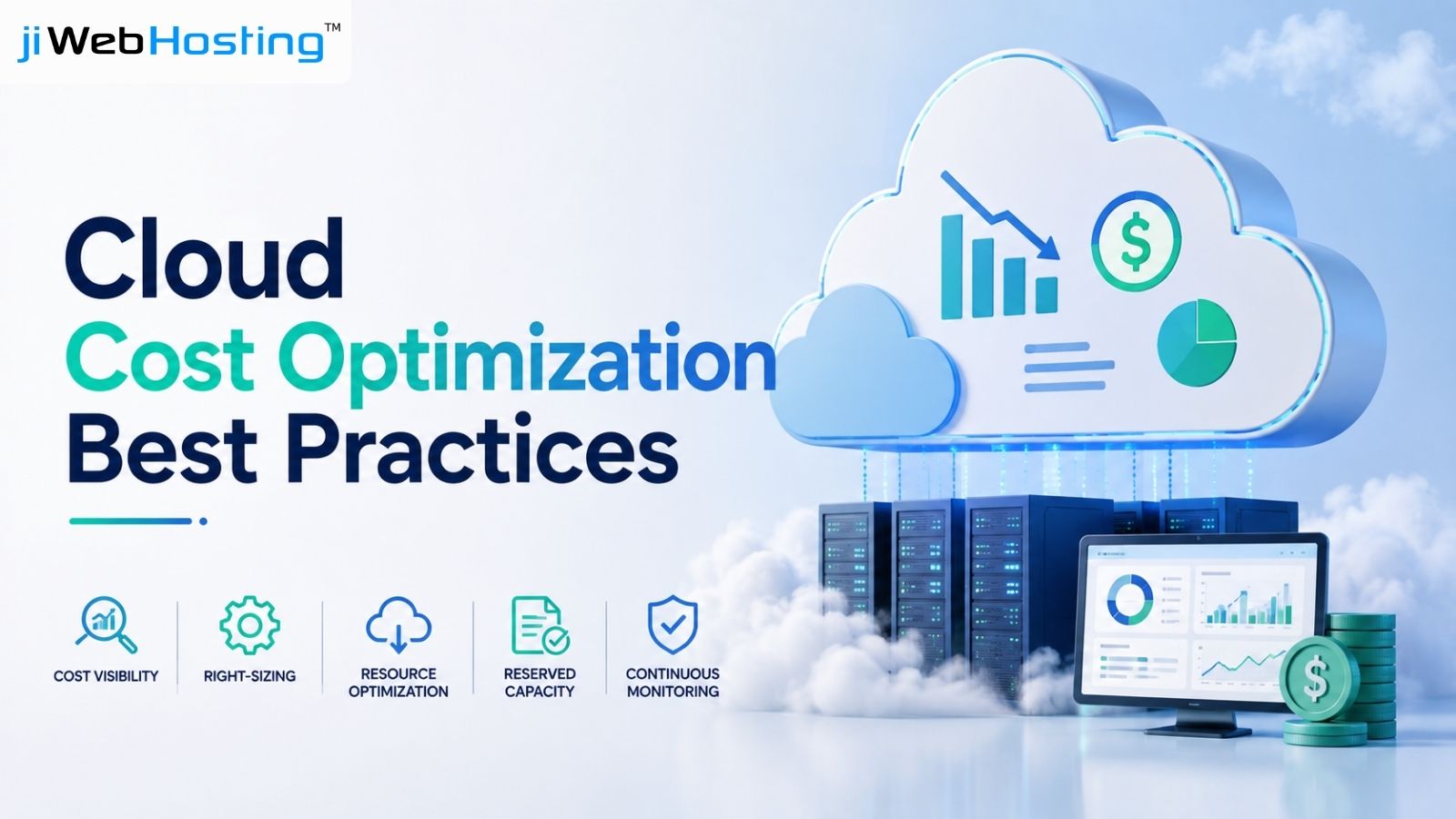
Cloud Cost Optimization is the process of managing and improving cloud infrastructure to achieve the best possible performance and business value while keeping expenses under control. It focuses on ensuring that businesses pay for the resources they actually need and use.
Effective optimization is not simply about reducing cloud spending. It is about finding the right balance between cost, performance, security, reliability, and scalability.
Key aspects of Cloud Cost Optimization include:
- Resource utilization: Businesses analyze how cloud resources are being used and identify underutilized or unnecessary servers, storage, databases, and applications.
- Cost visibility: Detailed monitoring helps businesses understand where their cloud budget is being spent and identify areas that require improvement.
- Resource right-sizing: Computing resources are adjusted according to actual workloads instead of maintaining unnecessarily large infrastructure.
- Automated management: Automation can help shut down unused resources, scale infrastructure according to demand, and prevent avoidable expenses.
- Continuous optimization: Cloud environments change as businesses grow, making ongoing cost monitoring and optimization essential for long-term efficiency.
Why Is Cloud Cost Optimization Important?
Cloud environments provide flexibility, but uncontrolled resource usage can quickly increase operational expenses. A structured approach to cloud cost management allows organizations to use cloud technology more efficiently while maintaining the infrastructure required for business growth.
Reduce Unnecessary Cloud Spending
Unused virtual machines, excessive storage, idle databases, and over-provisioned resources can increase monthly cloud bills. Cloud cost optimization helps identify these inefficiencies and allows businesses to remove or modify resources that are no longer delivering meaningful value.
Improve Resource Utilization
Businesses often allocate more computing, storage, or networking capacity than their applications actually require. Monitoring resource utilization helps organizations identify performance and capacity gaps, allowing them to allocate resources more accurately and improve overall infrastructure efficiency.
Support Business Scalability
A scalable cloud environment should expand when demand increases and reduce capacity when demand falls. Cloud cost optimization enables businesses to adopt flexible infrastructure models that support growth without requiring them to continuously pay for maximum capacity.
Improve Financial Predictability
Uncontrolled cloud usage can make monthly expenses difficult to predict. Effective cost monitoring provides greater visibility into resource consumption and spending patterns, helping businesses establish realistic budgets and make more informed infrastructure decisions.
Maintain Performance While Controlling Costs
Cost reduction should never come at the expense of application performance or reliability. A well-planned optimization strategy focuses on eliminating waste while retaining the resources required to deliver fast, secure, and dependable digital experiences.
Key Cloud Cost Optimization Strategies
Businesses can implement several practical strategies to improve cloud efficiency. The right approach depends on workload requirements, infrastructure architecture, application usage, and growth plans. The following strategies can help organizations establish a stronger and more sustainable cloud environment.
1. Right-Size Cloud Resources
Right-sizing means matching cloud resources with actual workload requirements. Businesses should regularly evaluate whether their virtual machines, computing instances, memory, and processing capacity are appropriately configured.
- Analyze CPU, memory, and storage utilization regularly.
- Identify over-provisioned computing resources.
- Reduce instance sizes where excessive capacity is unnecessary.
- Upgrade resources when workloads consistently require additional capacity.
Right-sizing can reduce waste while helping businesses maintain appropriate application performance.
2. Eliminate Unused and Idle Resources
Cloud environments can accumulate resources that were created for testing, temporary projects, discontinued applications, or previous business requirements. These resources may continue generating costs even when they are no longer needed.
- Identify unused virtual machines and databases.
- Remove outdated snapshots and unnecessary backups.
- Delete unattached storage volumes.
- Schedule regular infrastructure cleanup activities.
Maintaining an inventory of cloud resources makes it easier to identify unnecessary spending and keep infrastructure organized.
3. Implement Auto-Scaling
Workloads often change throughout the day, week, or season. Maintaining maximum infrastructure capacity at all times can result in unnecessary costs. Auto-scaling allows infrastructure to adjust according to real-time demand.
- Scale computing resources based on workload requirements.
- Increase capacity during traffic spikes.
- Reduce resources during low-demand periods.
- Establish appropriate scaling policies and thresholds.
This approach allows businesses to maintain performance during busy periods without continuously paying for peak capacity.
4. Choose the Right Pricing Model
Cloud providers typically offer different pricing structures designed for different usage patterns. Selecting the appropriate pricing model can significantly influence overall cloud expenditure.
- Analyze workloads before selecting pricing options.
- Use flexible pricing for changing workloads.
- Consider long-term plans for predictable workloads.
- Review pricing periodically as business requirements change.
Businesses should compare expected usage with pricing structures to determine which option delivers the best long-term value.
5. Optimize Cloud Storage
Storage costs can gradually increase as businesses accumulate databases, documents, backups, media files, logs, and other digital assets. A structured storage strategy helps organizations control these expenses without compromising accessibility.
- Remove duplicate and obsolete files.
- Classify data according to access requirements.
- Move inactive information to lower-cost storage tiers.
- Establish appropriate data retention policies.
For businesses managing significant digital content, Cloud File Hosting can provide a centralized environment for storing and accessing files while supporting better resource organization.
6. Monitor Cloud Usage and Spending
Visibility is one of the most important elements of effective cloud cost management. Businesses cannot optimize expenses effectively without understanding how resources are being consumed.
- Track cloud usage and expenditure regularly.
- Set budgets and spending alerts.
- Analyze costs by project, department, or application.
- Identify unusual increases in cloud consumption.
Regular monitoring enables organizations to identify problems early instead of discovering unexpected expenses at the end of a billing cycle.
7. Automate Cloud Cost Management
Manual cloud management can become difficult as infrastructure grows. Automation helps businesses establish consistent processes for resource management, monitoring, and optimization.
- Schedule non-production resources to shut down during inactive hours.
- Automate resource scaling according to demand.
- Create alerts for unusual spending patterns.
- Establish automated cleanup policies for temporary resources.
Automation reduces human error and makes optimization a continuous part of infrastructure management rather than an occasional activity.
Common Cloud Cost Optimization Mistakes to Avoid
Cloud optimization can become ineffective when businesses focus only on reducing costs without considering infrastructure requirements. Avoiding common mistakes helps organizations achieve sustainable savings while protecting performance and reliability.
Focusing Only on Cost Reduction
Reducing cloud expenditure should not mean removing resources without understanding their purpose. Excessive cost-cutting can create performance bottlenecks, downtime, or security risks. Businesses should evaluate cost alongside application performance, reliability, scalability, and user experience.
Ignoring Underutilized Resources
Many organizations focus on major infrastructure expenses while overlooking small, recurring costs. Idle instances, unused storage, outdated snapshots, and unnecessary data transfers can collectively create substantial expenses. Regular resource audits help identify these hidden sources of cloud spending.
Failing to Monitor Cloud Usage
Cloud environments can change rapidly as applications, users, and workloads evolve. Without continuous monitoring, businesses may not notice sudden increases in resource consumption. Establishing dashboards, budgets, alerts, and regular cost reviews helps maintain greater financial control.
Overlooking Storage Lifecycle Management
Keeping every file, backup, and log in high-performance storage can become expensive over time. Businesses should classify data according to access frequency and retention requirements. Moving inactive information to appropriate storage tiers can reduce costs while preserving important business data.
Not Planning for Future Growth
Cloud infrastructure should support current requirements while remaining prepared for future expansion. Selecting resources without considering growth can lead to repeated infrastructure changes and inefficient spending. Businesses should develop scalable architectures that accommodate changing workloads and customer demand.
Benefits of Implementing Cloud Cost Optimization
A well-planned Cloud Cost Optimization strategy provides more than immediate savings. It can improve infrastructure efficiency, strengthen financial planning, and help businesses make better technology decisions as they scale.
Lower Infrastructure Expenses
Optimizing resources allows businesses to eliminate unnecessary cloud expenditure while retaining the infrastructure needed to operate effectively.
- Reduce spending on idle resources.
- Optimize computing and storage capacity.
- Minimize unnecessary infrastructure duplication.
- Improve overall return on cloud investment.
Better Resource Efficiency
Efficient resource allocation ensures that businesses receive greater value from their cloud infrastructure and avoid paying for unused capacity.
- Match resources with actual workloads.
- Improve utilization across infrastructure.
- Identify resource inefficiencies quickly.
- Reduce unnecessary capacity.
Improved Scalability
Cloud optimization supports flexible infrastructure that can adapt as business requirements change.
- Scale resources according to demand.
- Support traffic increases more efficiently.
- Reduce capacity during low-demand periods.
- Prepare infrastructure for future growth.
Greater Financial Visibility
Effective cloud cost management provides businesses with clearer information about how their technology budget is being used.
- Track spending across cloud resources.
- Establish meaningful budgets.
- Identify unexpected cost increases.
- Improve technology investment planning.
Enhanced Operational Performance
Optimization can improve infrastructure organization and operational efficiency while maintaining the resources necessary for dependable applications.
- Reduce infrastructure complexity.
- Improve workload management.
- Automate repetitive cloud management tasks.
- Maintain reliable application performance.
Choose jiWebHosting for best Cloud Hosting Services
Choosing the right hosting partner is essential for businesses that want to balance performance, scalability, security, and cost. At jiWebHosting, we provide hosting infrastructure designed to support different business requirements, from websites and applications to data-intensive digital platforms.
As a leading web hosting solutions provider, we focus on delivering reliable infrastructure and flexible options that can adapt to changing business needs. Our Cloud Hosting services are designed to help businesses maintain dependable digital operations while making efficient use of hosting resources.
Businesses can choose jiWebHosting for:
Reliable Cloud Infrastructure: We provide dependable hosting environments designed to support websites, applications, and growing digital operations with stable performance.
Flexible Hosting Options: Our solutions can be adapted according to business requirements, helping organizations select infrastructure appropriate for their workloads and growth plans.
Cloud File Hosting: Businesses can manage and access important files through scalable cloud-based storage environments designed for convenient digital operations.
Customizable Hosting Solutions: We provide customizable hosting solutions that can be aligned with application requirements, storage needs, performance expectations, and business objectives.
Cost-Conscious Hosting: Our goal is to provide hosting services at affordable prices without compromising the essential performance and reliability businesses need.
Scalable Infrastructure: Businesses can adopt infrastructure that supports changing workloads and future expansion without requiring a complete shift in their hosting environment.
Professional Support: Our team helps businesses identify suitable hosting options and infrastructure configurations based on their technical and operational requirements.
Conclusion
Cloud infrastructure provides businesses with the flexibility to scale applications, manage data, support remote operations, and deliver digital services without depending entirely on traditional physical infrastructure. However, without proper monitoring and planning, cloud expenditure can grow unnecessarily.
Effective Cloud Cost Optimization focuses on finding the right balance between infrastructure performance, scalability, security, and cost. Strategies such as right-sizing resources, eliminating unused infrastructure, implementing auto-scaling, optimizing storage, selecting suitable pricing models, monitoring usage, and automating cloud cost management can help businesses achieve greater efficiency.
Whether you are launching a new application, managing business data, or scaling an existing digital platform, jiWebHosting can help you choose an appropriate hosting environment. Get in touch with jiWebHosting today to explore efficient, scalable, and cost-effective cloud hosting solutions for your business.
FAQ's
1. How can businesses identify unnecessary cloud expenses?
Businesses can analyze resource utilization, billing reports, storage consumption, idle instances, and data transfer costs. Regular audits help identify over-provisioned, unused, or duplicate resources that can be removed, resized, or optimized.
2. Does Cloud Cost Optimization affect application performance?
No, when implemented correctly. Cloud Cost Optimization aims to balance cost with performance by right-sizing resources, using auto-scaling, and monitoring workloads to ensure applications continue receiving adequate computing, storage, and networking capacity.
3. What role does automation play in cloud cost management?
Automation helps control cloud spending by automatically scaling resources, shutting down inactive environments, removing temporary resources, and generating spending alerts. This reduces manual intervention, prevents resource waste, and supports consistent cloud cost management.
4. How does auto-scaling help reduce cloud infrastructure costs?
Auto-scaling adjusts computing resources according to workload demand. Businesses can increase capacity during traffic spikes and reduce resources during quieter periods, preventing them from continuously paying for infrastructure designed only for peak usage.
5. How can cloud storage costs be optimized?
Businesses can classify data according to access frequency, remove unnecessary files, establish retention policies, and move inactive information to appropriate storage tiers. Cloud File Hosting can also provide structured, scalable storage for business data.
6. What is right-sizing in cloud infrastructure?
Right-sizing involves adjusting computing resources to match actual workload requirements. By analyzing CPU, memory, storage, and network utilization, businesses can reduce oversized instances while ensuring applications continue receiving sufficient resources for reliable performance.